
Biography
I am an assistant professor in computer science. My research interests include programming languages and research software engineering. I am part of the Programming Research Lab in Prague.
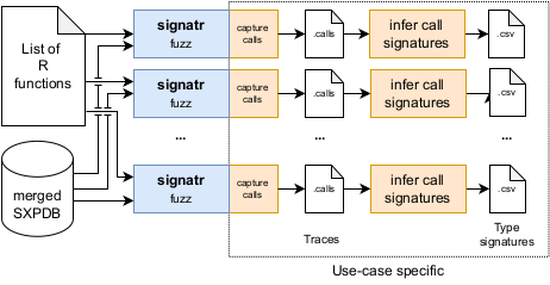
I apply my PL research to the R language: JIT compilation, benchmarking, type systems, large code analysis on R code bases, reproducibility, and fuzzing and testing. I am also the developer of the mutator mutation testing package for R.
During my PhD, I worked on Antescofo at Ircam, under the supervision of Florent Jacquemard and Jean-Louis Giavitto, and more generally on systems with languages that express complex temporal relations.
I am also interested in linguistics and language education through technology.
Download my resumé.
- Fuzzing and testing
- Programming languages
- R language
PhD in Computer Science, 2019
Sorbonne université
Masters in Computer Science, 2015
École Normale Supérieure de Rennes
BSc in Computer Science, 2013
École Normale Supérieure de Rennes
Experience
eval in R for CVUTResearch at Ircam in the Repmus group and taught computer science.
Responsibilities include:
- Research in computer music and programming languages on Antescofo
- Taught bachelor students
- Supervized research projects of master students
Thesis Supervision
- Vojtěch Rozhoň — Nested Loops and Path Explosion in Symbolic Execution, Master’s thesis, defended May 2024, grade A
- Miroslav Škrabal — Interpretation and Differential Fuzzing of the Vyper Language, Master’s thesis, defended January 2025, grade A
- M. Makovec — Fuzzing Graphical User Interfaces, Master’s thesis, in progress, expected defense May 2026
Also supervised 7 B.Sc. theses at FIT CTU (2023–present).
Teaching
I currently teach the following courses at the Faculty of Information Technology, Czech Technical University in Prague. Both are taught in English.
Programming Language Seminar (NI-PLS)
A reading group introducing students to programming language research through paper presentations and discussions. Organized jointly with MFF, Charles University, through the Prague Programming Languages and Systems Research Network.
Advanced Program Testing (NI-APT)
Advanced techniques for finding bugs, including specification and structural testing, property-based testing, fuzzing, and symbolic execution. Students put these techniques into practice through a programming project where they have to build a fuzzer for C programs.
Projects
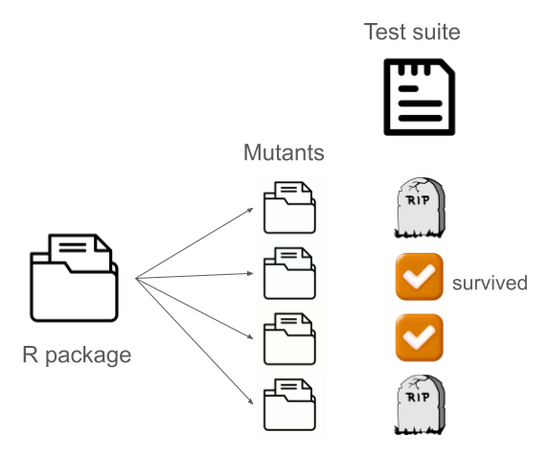
Mutation testing for R with mutator
mutator brings mutation testing to R packages: it systematically mutates source code, runs the test suite against each mutant, and reports how many are killed, survived, or timed out.
R4R: Reproducibility for R
The project focuses on the reproducibility of computational notebooks in R.
Data Bugs
The goal of this project is to develop new programming language technologies to assist data scientists, using the R language for empirical validation of our novel ideas. The project is financed by the operational program Jan Amos Comenius and spans from March, 2023, to March, 2025.

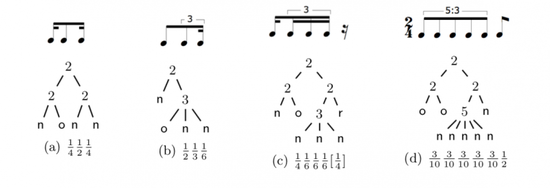
Rhythm Quantization
Rhythms are represented using trees and quantization is performed by applying rewrite rules on the rhythm trees.
Recent Publications
Contact
- pierre.donat.bouillud@fit.cvut.cz
- Thákurova 9
16000 Praha 6 - Enter the Civil Engineering Building and go to Floor 12.
- DM Me